Walk down the supplement aisle and the same handful of plant names keeps showing up on men's formulas: Tongkat Ali, Maca, Ashwagandha, Horny Goat Weed. They come from very different corners of the world, but they share one thing. Each has been part of a traditional wellness practice for generations before it ever landed in a gummy or capsule.
Here is a straightforward look at where each one comes from and why it is so often included.
Tongkat Ali (Eurycoma longifolia)
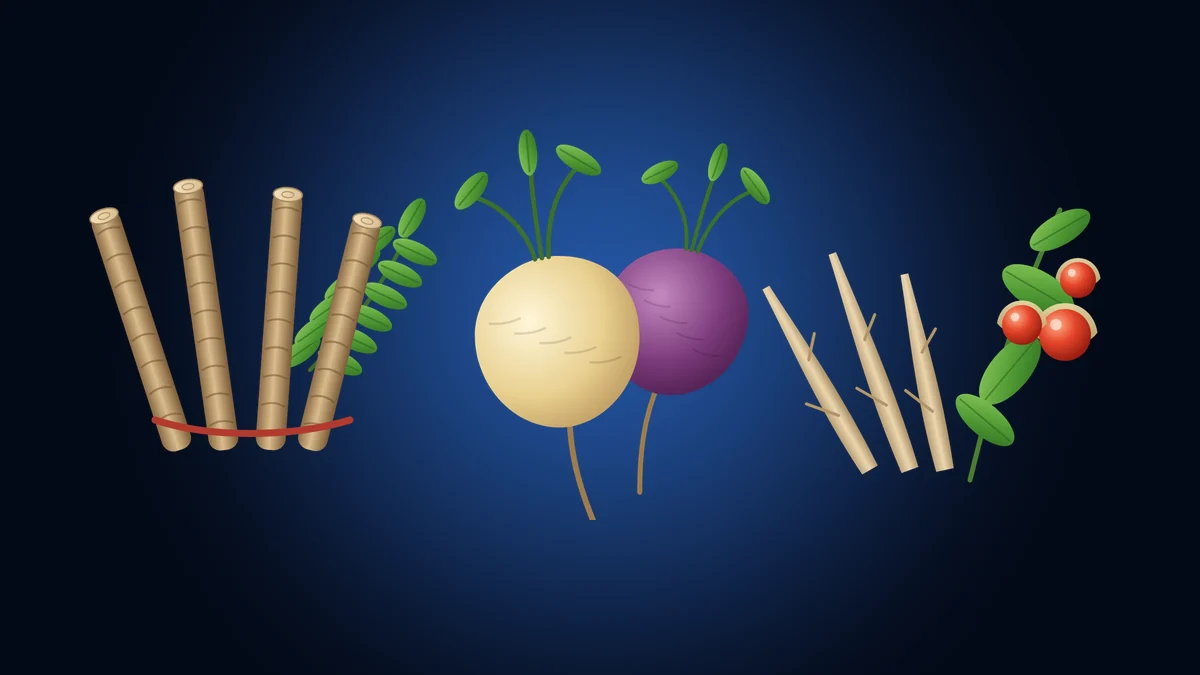
Tongkat Ali is a slender tree that grows in the rainforests of Malaysia, Indonesia and Thailand. Its root is the part that gets used. In traditional Malay herbal practice it was prepared as a tonic for men, and the nickname often translated as "Ali's walking stick" hints at its reputation for vigor.
Today it is one of the most widely researched botanicals in the men's wellness category. If you see it on a label, look for the form used (root extract is common) and the amount per serving on the Supplement Facts panel.
Maca root (Lepidium meyenii)
Maca is a hardy root vegetable related to radishes and turnips. It grows at altitudes above 4,000 meters in the Peruvian Andes, where few other crops survive. Andean communities have eaten it as a staple food for centuries, dried, ground or cooked into porridge.
Because it has a long history as a food, Maca is often described as one of the gentler botanicals. In supplements it usually appears as a powder or concentrated extract.
Ashwagandha (Withania somnifera)
Ashwagandha is a small shrub in the nightshade family and one of the cornerstones of Ayurveda, the traditional medicine system of India. It is classed as an adaptogen, a term used for plants traditionally taken to help the body adapt to everyday physical and mental stress.
It is worth knowing that ashwagandha is not suitable for everyone. People with thyroid conditions, autoimmune conditions, or those taking sedatives should speak with a doctor before using it.
Horny Goat Weed (Epimedium)
Despite the memorable name, Horny Goat Weed is a group of low-growing leafy plants native to China and parts of the Mediterranean. It has been used in traditional Chinese herbal practice for a very long time, and its leaves are the part most often used today.
Where L-Arginine and grape seed fit in
Not every ingredient in a men's formula is an herb. L-Arginine is an amino acid, one of the building blocks of protein, and the body uses it to make nitric oxide, a molecule involved in relaxing blood vessels. Grape seed is naturally rich in proanthocyanidins, plant compounds with antioxidant properties.
How to read a men's formula label
- Check the Supplement Facts panel. It lists what is inside each serving and in what amount.
- Look at the serving size. One gummy a day is very different from four capsules a day.
- Read the warnings. Pay attention to anything about medications, blood pressure or medical conditions.
- Be realistic. Botanicals are not medicines, and results vary from person to person.
Above all, if you take prescription medication, especially for blood pressure or heart health, speak with your doctor or pharmacist before adding any new supplement.
Related reading
Read more: all six HorseFil ingredients, energy and vitality and ingredient research.